Change, But How?
The AI S-Curve will drive great change. The question for enterprises is - what does real organisational change look like in this world? And how to drive it?

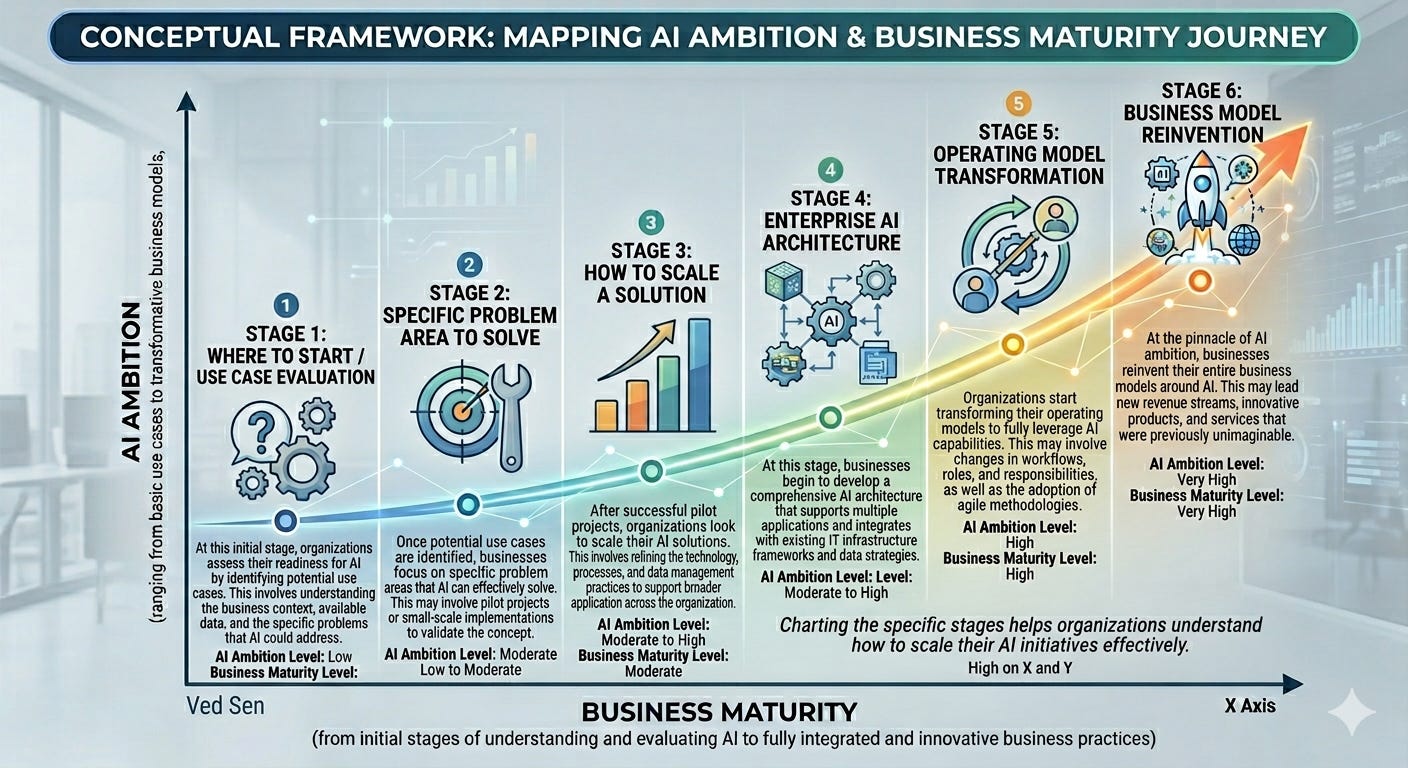
We know today that AI is probably going to change a lot of things about how work gets done and how organisations are designed. The problem is that while we have a lot of technological abilities and tools, we are wandering in the mist when it comes to the changes we might need to make to get to the stage where we reap the value of AI.
I. Speeding Up The Organisation
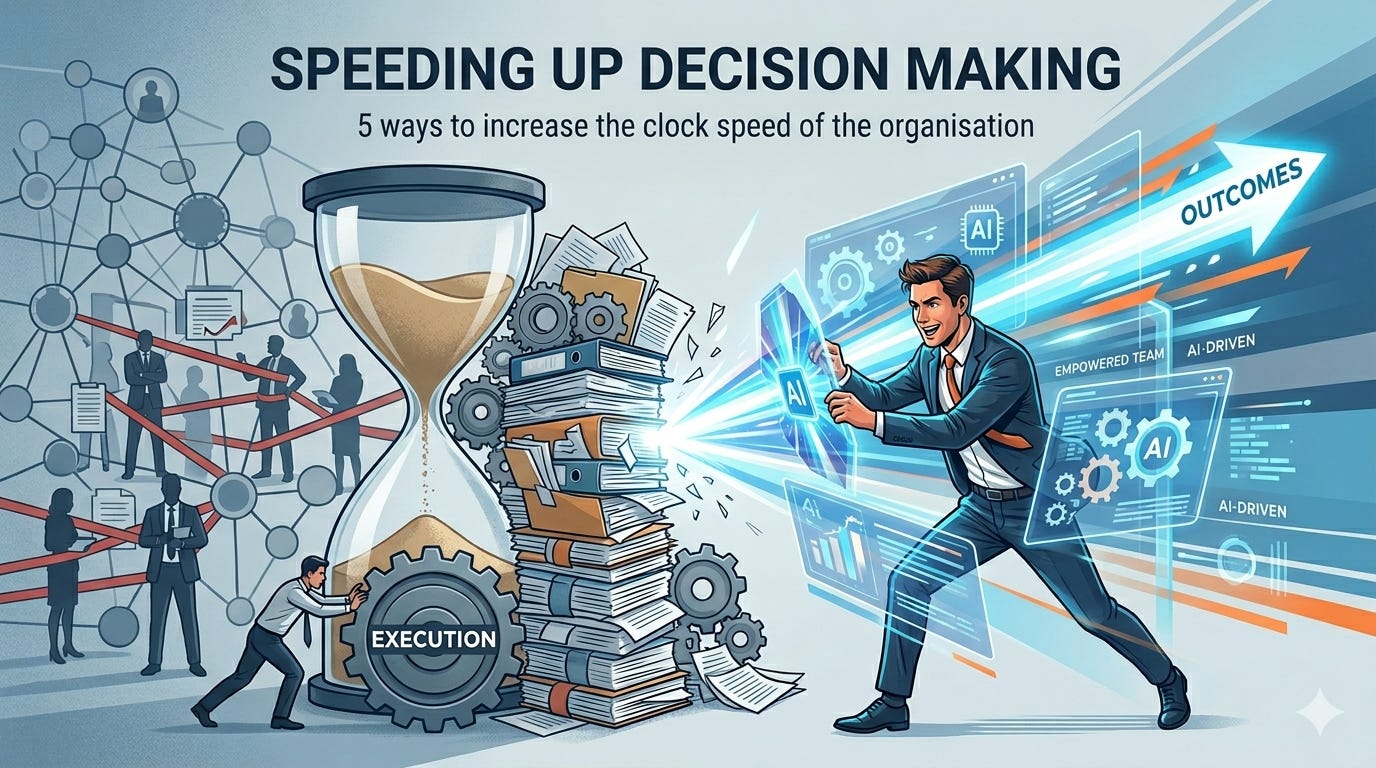
You may have seen the blinding speed at which companies like Claude, Google, and OpenAI are shipping products now, with new versions and tools landing every week. And yet we haven’t quite seen this kind of speed or way of functioning across other industries and outside of Silicon Valley.
So how can we use AI to speed up our organisations in the same way?
Let’s remind ourselves of the 2 key drivers of speed for the AI giants.
(1) AI writing code at a scale, quality, and consistency that is far ahead of human capability
(2) Rewiring of organisational processes - such as release management, product roadmapping, and the retooling of internal culture to enable this speed to market.
The AI tools are increasingly available to many others, but the process and culture reboot are less easy to adopt because they are not a part of a product or solution you can buy and implement.
Most large organisations 2 additional challenges
(1) They are faced with legacy systems, tools, and processes that they cannot wish away or easily upgrade just by throwing more money at it.
(2) They are not software product companies, so many parts of the business doesn’t work at AI speed, not matter how quickly AI can write code.
It is clear though, that AI adoption is going to be key to business success, and the greatest constraint to AI adoption is not the availability of technology but the ability of the organisation to absorb the new tech and to drive actual business change. Which boils down to speed of decision making - whether for running the business, or for changing the business.
The problem of speed and change
The speed at which decisions are made in organisations is sometimes constrained by things like physical supply chains that have limits on how quickly you can change them. But the biggest gap between the possible and actual speeds at which most businesses run (or change) lies in the decision making practices and design.
There is a very long list of ideas for speeding up decision making in organisations, but here are my top 5:
Structure and Culture: Flattening the organisation sounds obvious but requires a lot of rethinking of spans of control, and review mechanisms. But you can still get the benefits of flattening by pushing decisions down and encouraging ownership. And that includes supporting the teams through the occasional mistakes. This also includes a culture where a junior person feels comfortable sharing their point of view to a senior person about an area they are competent in.
Actionable: giving junior people access to AI tools and the training and encouragement to use it effectively is one way of enabling better decision making across the business.
Talent density over headcount: a natural conclusion from the earlier point: hiring for high-capability individuals and keeping teams lean. This is also a significant shift of thinking, especially in professional services firms that bill by the hour, since a move to a highly trained core team with the right tooling as a preferred model, will also require a rethink of pricing models.
Actionable: all future hiring should focus on hiring people who are high talent/ capable of high growth. Good enough isn’t good enough.
Templatize decisions - many leaders have a need to be in the room, and go through information themselves in order to get to a decision. This makes them a bottleneck, and days and weeks are lost because of their availability. When there are multiple such people in the organisation who have the same challenge, it can take an entire quarter just to get 2-3 senior people aligned on a key initiative. Task #1 as decision makers is to constantly make our decision models explicit, and accessible to others. This allows our teams to arrive at similar decisions without us being there necessarily. Task #2 is to get to an organisational version of this so that people across the business make calls based on similar parameters - clearly a much harder task.
Actionable: Think about the decisions you might make regularly - such as qualifying new sales opportunities, or allocating resources to a project. And build rules that can be put into a reusable framework. For every one repeatable decision you can turn into a template, you’ll save hundreds of hours, and the organisation will move much faster.
Reduce information asymmetry: Many decisions stall because the person with authority doesn’t have the information, and the person with the information doesn’t have the authority. Solving this isn’t just about transparency — it’s about designing information flows so the right people are informed by default, not on request. But even more importantly it’s also about designing decision systems so that the right information is available at the point of decision making, irrespective of who is making the decision.
Actionable: to build on the point about templates, for any such templatized decision, identify the key information elements needed and build it into the framework or template. So if your sales qualification depends on projected profitability, it needs to be made available as a part of the template. This is in a way just creating data pipelines for decisions.
The fully loaded start-up: creating a small, empowered team, giving them the right tools, and allowing them to cut through the bureaucracy and clutter and the admin overload. In our own innovation team, we have been thinking of the idea of a ‘fully loaded developer’ - one very good person with all the AI tools, who can replace a squad. In fact. Thanks to the march of AI systems, ever smaller teams can take on more complex jobs and execute them.
Actionable: For your next key project - start with a core team of 3-5 people, which should include a mix of technical, commercial and specialised skills. Give them a choice of the best of breed tools. And only add people by exception and based on specific asks by the core team.
If I was to summarise the problems faced by most traditional organisations, I would define it as Sequential Decision Opacity. Decisions are made sequentially by a series of leaders, with each person bringing their subjective criteria, with no underlying organisational decision making template or culture of openness.
If speed is going to be a critical competitive parameter, then you have to sort out your decision making models first.
II. Working With Agents
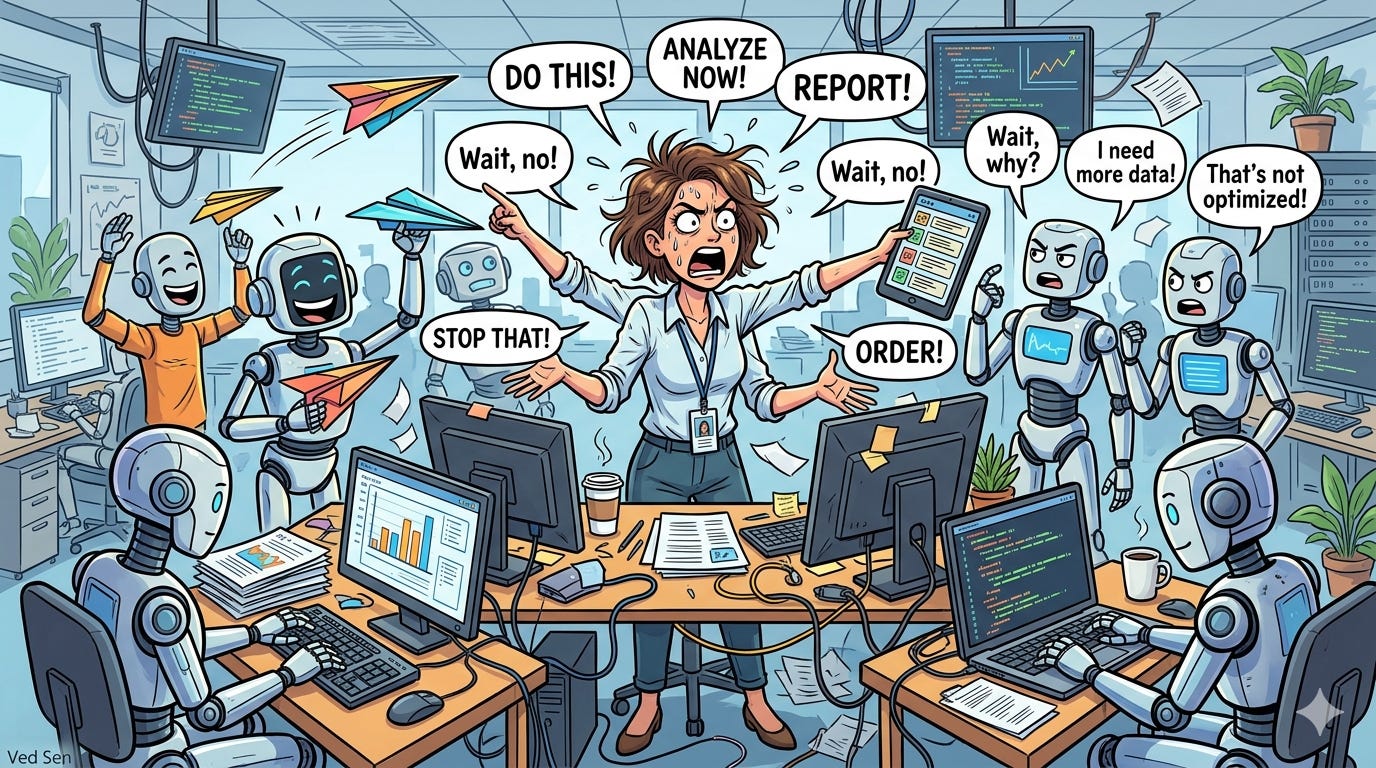
Try this exercise. Imagine that you get to work one day, but you’re actually not allowed to do anything. Instead, you are given an army of young, smart, knowledgeable graduates who will do all your bidding. You can have as many of them as you want on your team. The only catch is, you have to get everything done by them. Whether it’s writing an email, or building an excel sheet to project profitability, or creating a presentation or talk. They don’t forget anything, and they don’t get tired. They don’t make basic errors. If you’re like me, you will find some parts of this fun and load relieving. And some part of this will frustrate you intensely. Not just because we all want to roll up our sleeves and do stuff by ourselves, but also because not everything we do can be converted into an effective instruction. And these grads - they’re smart, but they’re grads. So they will usually produce good, or very good work, but not quite excellent all the time. So you’ll need to iterate with them.
Welcome to the world of working with agents. And yes, in this world you won’t have these make-believe constraints I just described. But here’s the challenge:
Agents do some stuff incredibly well and some stuff is just average to good (relative to us). And we’re still finding our way around which is which.
We are hardwired to do somethings ourselves. It validates us. It satisfies us. And it gets us into flow states which is a blissful state of mind. Nobody wants to give up that.
There’s a bunch of stuff we do naturally, in a particular way, which works really well for us, which is incredibly hard to articulate into a set of explicit instructions. I think this is the most underrated challenge of working with AI agents.
And just like the smart graduates, the agents will get better. The communication will improve. We will get better at working with them. And in fact they’ll get smarter much faster than humans do. And over time they’ll remember stuff better than humans as well. But we’re going to have to put ourselves through that messy period where all of the above will irritate the hell out of us.
And that’s probably why ‘change’ sounds much easier than it actually is, even at an individual level, let alone as an organisation.
After all, if we’re going to work with AI agents, the ability to instruct and manage them is going to to have to be a core skills. And successful professionals of tomorrow will not be those who can do the job better themselves, but those who know how to instruct and iterate better with AI agents.
Actionable: Practice turning your daily activities into instructions that an AI agent might be able to do if it had access to the right data. Try running these through whatever enterprise AI tools you have to see where it comes up short - is it access to data? The quality of your prompt? Or the limitation of the agents? Only one of these is a real constraint.
III. Architecting For Change
Owen Jennings, the Business Lead at Block spoke recently in an A16Z podcast. (What Happens When a Public Company Goes All In on AI, 1 Apr 2026). I found his comments interesting. Especially as Block a public company with an installed base of customers, so it’s not like a start up in a garage.
The jury seems to be out as to what the real reasons for Block’s layoffs are. Block has undertaken 3 rounds of layoffs in the past 3 years. Each year, the layoffs have been framed differently, and the the company has gone from 13,000 to 6,000 people. The latest round involving around 1600 people was billed as an AI led restructure, but cynics have pointed out that this might be AI-washing a financial restructure. But it’s Block’s AI approach that caught my eye.
Here are the top 3 things I took away from the podcast about managing the change.
Create the no-fly zones. Block created it’s ‘red lines’ for the reductions. Compliance and compliance tech wasn’t touched, even though all the cuts were in the tech and dev teams. Compliance was seen as too high a risk. Other worst case scenarios around customer trust helped create other clear lines. Block seems to have ended up hiring back some people it had let go, so even with the no-fly zones, it probably let go of some people it shouldn’t have.
Block had already created an ‘Agent Harness’ called Goose (a nod to the Co-Pilot in Top Gun) - which acts as a middle layer, holds the organisational contexts, but can be used to access any of 120 AI models. All work gets routed through Goose and the internal automation layer (G2). This is, I think a fundamental aspect of enterprise AI architectures, without which you’ll get a lot of piecemeal AI implementations leading to AI debt. The reported savings from Goose was said to be around 8-10 hours / week for each developer.
The Dev Teams went from 15 member teams to squads of 1-6 members but with a much greater amount of tools. (and $2000 on tokens). Workflows in product development went from sequential to parallel. Which means a developer could have multiple agents working on different pieces of the code and oversee all of them. The challenge is that this requires a much higher ability to manage context switching, which may require training. This is the same change as we talked about earlier.
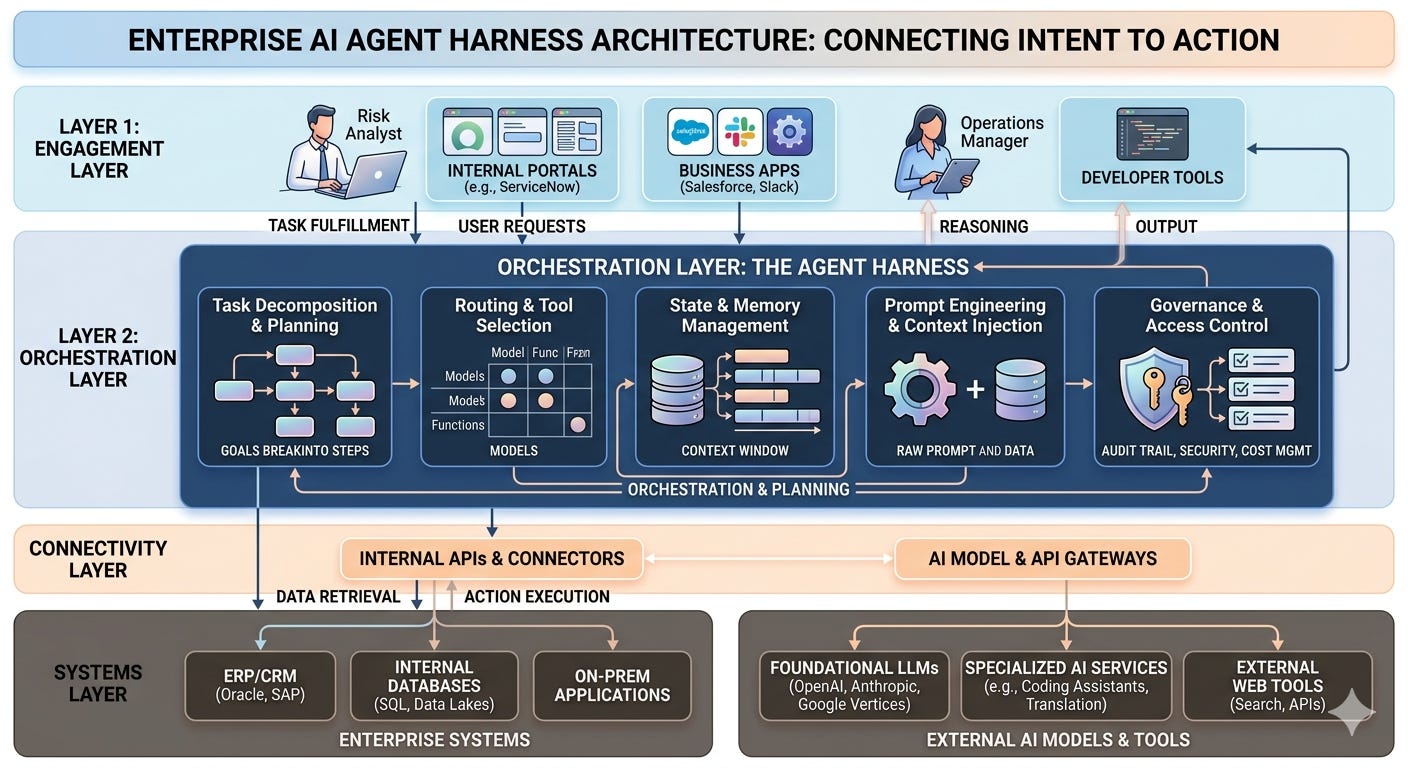
Actionable: build and mature your AI orchestration layer and reimagine your workflows before making any significant cuts. And invest in training your teams on working with agents, multi-tasking, and managing across multiple contexts.
IV. Design Exponential Small Change
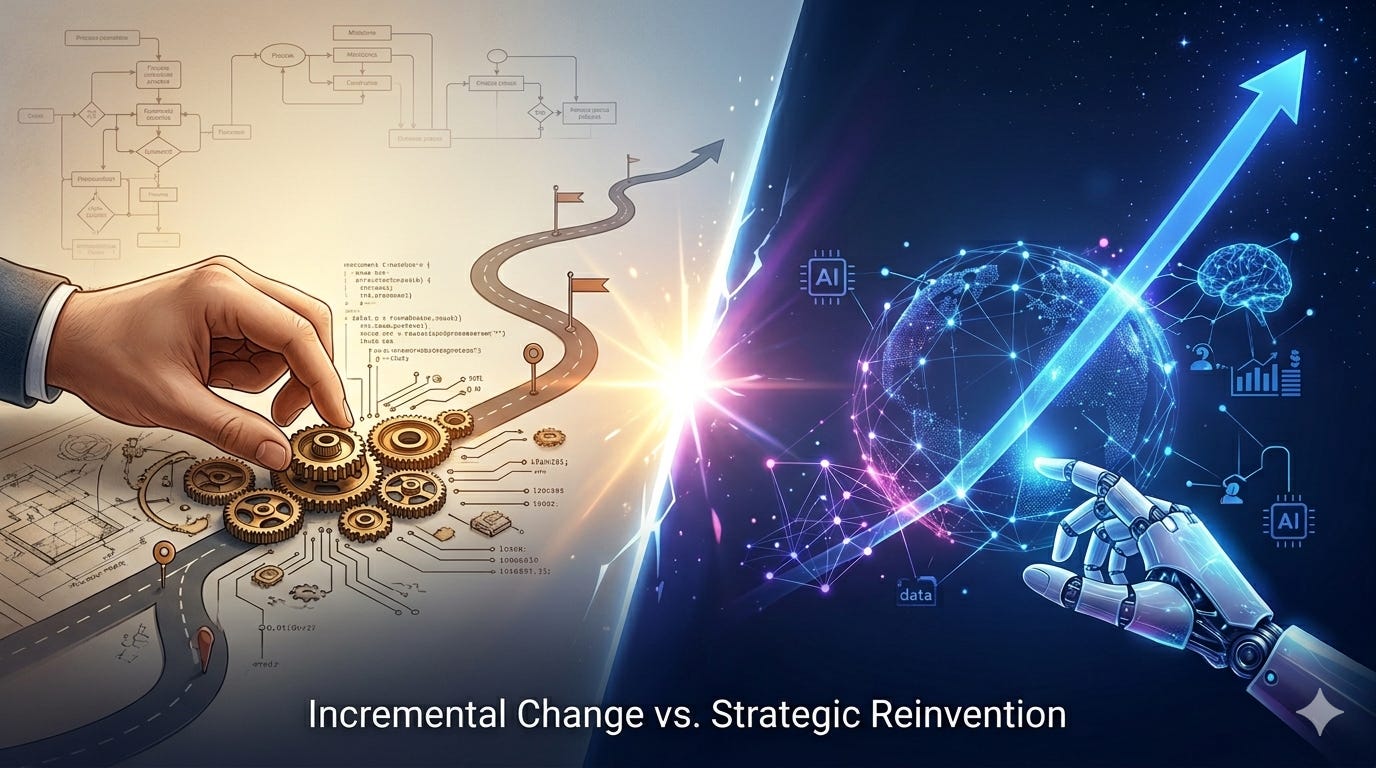
I was recently asked an interesting question by a client - should we use AI to fundamentally rethink our business, or should we look for incremental changes. I think the mood in the room was basically that we get the small changes, but how do we drive for the big reinvention?
My view has always been that you have to drive a 2 track approach - think deeply about reinvention but also run a number of small projects that create momentum, learning, and change propensity. In fact the big reinvention comes not from a single project but from a series of aligned small initiatives that build on each other.
If we really think about it, how many business have really reinvented themselves with AI?
Software product companies are probably in that phase. As are SaaS companies, per force. And beyond that I would think that media and financial services are most likely to have really reinvented themselves, but I couldn’t off the top of my head think of some obvious examples. So after the session, I went looking.
Lessons from Successful Transformations
There some obvious and well cited examples. Everybody has heard about John Deere’s redefining itself as a services, data & intelligence business. Maersk went from being a shipping company to a supply chain integrator by using AI to optimise shipping routes, predict maintenance needs, and demand forecasting. The product is end-to-end visibility and predictability, not vessels. Kaiser Permanente used AI to change how notes are created from Physician sessions across 600 healthcare centres and 40 hospitals.
When you look hard enough these stories do come up. But as you can see, they are still few and far between, which is not surprising. It takes 2-3 years for the real change to kick in following the mass adoption of any significant new technology. Uber started in 2010, 3 years after the smartphone was launched. Lyft followed a couple of years later. Kodak filed for bankruptcy in 2012
Business Model vs Operating Model Transformation
Look closely, and you’ll see 2 distinct types of reinvention. (a) business model reinvention (2) operating model reinvention. Put simply, a business model reinvention changes how a company earns revenues, and what it gets paid for. An operating model reinvention changes how a company organises itself to deliver what it sells. In the above examples, Kaiser is clearly an operating model reinvention, whereas John Deere did actually change what they sold and what they were being paid for.
Business model reinvention is, needless to say, harder, riskier, and often also assumes an operating model overhaul. For all the impact of AI on software businesses, it is still at present an operating model change. Customers are still paying for the same things in the same ways. If a software company charged enterprise clients for managing tech debt, or business outcomes, and not for software licenses, that would be an example of a business model change. Hasn’t happened yet.
The Playbook
As to the right way of doing it, there’s enough evidence to suggest a playbook with some key principles:
Lead with problems. Running use cases forces you to confront where your data actually is, what your processes really look like versus how you think they work, and where human judgment is irreplaceable versus where it’s just inertia. That grounding is invaluable for reinvention thinking. AI high performers are nearly three times as likely as others to say their organisations have fundamentally redesigned individual workflows (McKinsey research) and this intentional redesigning of workflows has one of the strongest contributions to achieving meaningful business impact of all factors tested. The use cases are effective stepping stones and forcing functions.
Avoid a Pure Bottom Up Approach: Many companies take a ground-up approach, crowdsourcing initiatives that they then try to shape into something like a strategy. The result: projects don’t match enterprise priorities, are so rarely executed with precision, and almost never lead to transformation. Companies that approach business model reinvention iteratively are most successful. Once the strategy is clear, companies can benchmark competitor investments and decide whether to lead, follow quickly, or adopt cautiously. (PWC Research).
Think Big, Start Small: this advice never gets old. You have to think big in terms of transformation, opportunity, reinvention and even cannibalisation. And you can think in 3-5 year horizons for these big changes. But action has to be in 3-6 month cycles. First, because bigger changes become exponentially inefficient and often ineffective. And second, because with the pace of change of technology, you may need to rethink both your methods and your vision every 6 months. For example, 2 quarters from new we might be testing amazing physical AI models, experimenting with Anthropic’s Mythos, considering Chinese frontier models, or be experiencing the great AI crash.
Our Experience
AI is new, and every time you go out to do an AI project in an enterprise environment, you get onto a particularly steep learning curve, about the real constraints, costs, complexities, and tradeoffs.
I believe that in this kind of unknown area, each projects opens a door to another one and shows you value that you couldn’t otherwise see. Our work in incident management with AI led immediately to change management as an area because multiple clients have told us that there is very high correlation between changes and incidents. It seems obvious in retrospect but nobody thought about this at the start.
And it’s a reminder that it’s incredibly hard to think exponentially. There might be moments where you can see a path to a 10x future, but by and large exponential change still confounds us. So transformation strategies work as a Northstar, but execution is modular.
Actionable: for any significant change, think in terms of roadmaps with clear milestones and segments that can be executed in 3 months with periodic reviews of technology advancements which can be coopted into your roadmap.
V. Change, But Who?
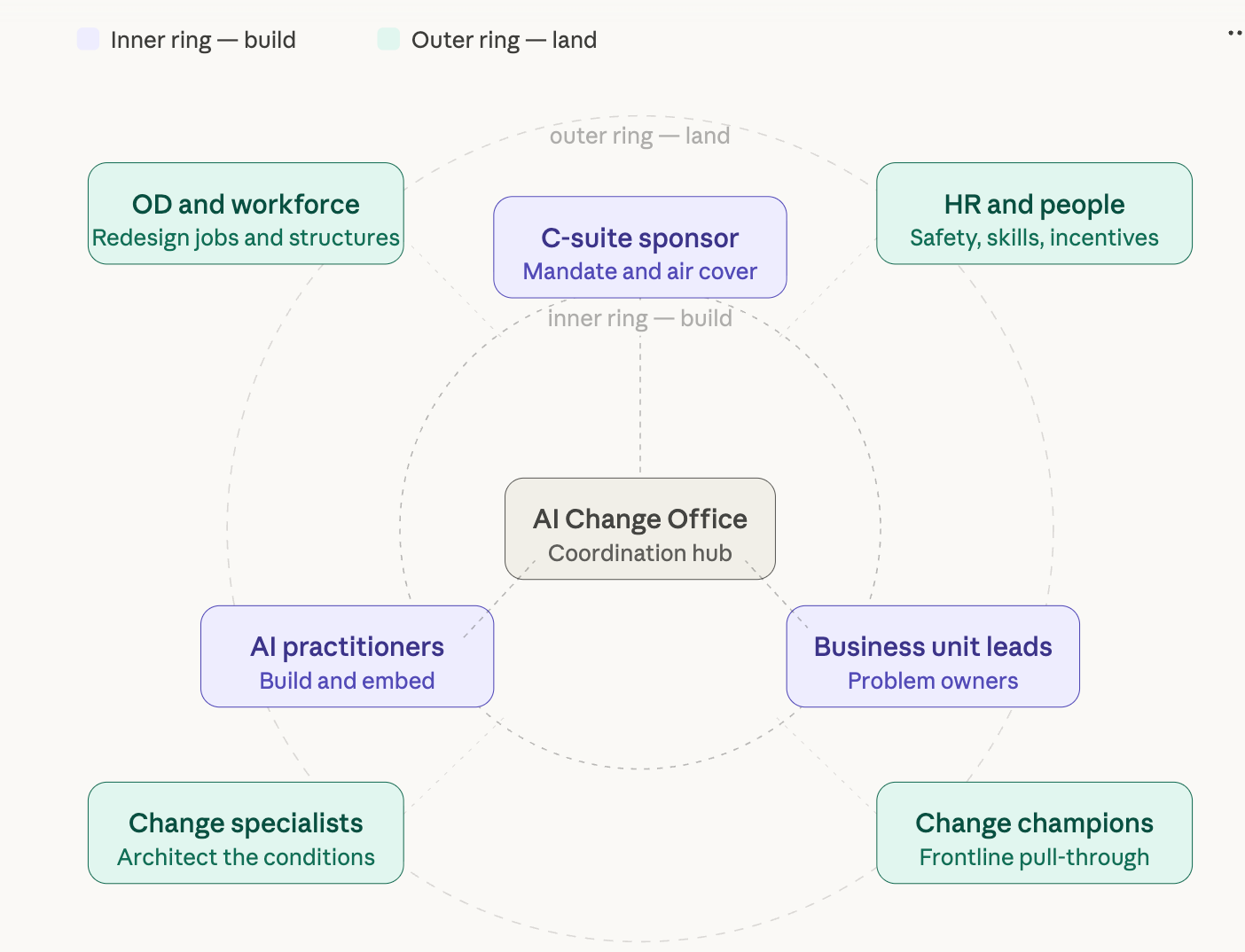
Who should be involved in the change process? This is a question that probably bears some thinking. The idea of an Change office is alluring but it should probably be more of a core group of senior people driving this change consciously. The 2 layer construct below is useful to think about because there is a role for a plan and review team as well as a deploy, learn, and detail team. The real value may be in how well these 2 layers communicate, especially feeding back to the senior planners about what isn’t working.
The biggest danger in this environment is for leaders to assume they know all the answers, and a culture where the front line and junior teams are too diffident to tell the leaders that their ideas aren’t all correct all the time.
After all, change isn’t really optional. Your organisation is changing every day whether you like it or not. Culture is constantly evolving. The environment impacts the edges of your business. Every person leaving or joining changes your business a little bit. And every key decision made at the top has a ripple of change. The difference is actually between managed and unplanned change.
Actionable: think about constructing a group that is both cross functional and across levels that can be seen as the stewards of change. Not to micromanage the change but to act as guardians and enablers, and also monitor and measure the changes to create a change roadmap.
VI. The More things change…
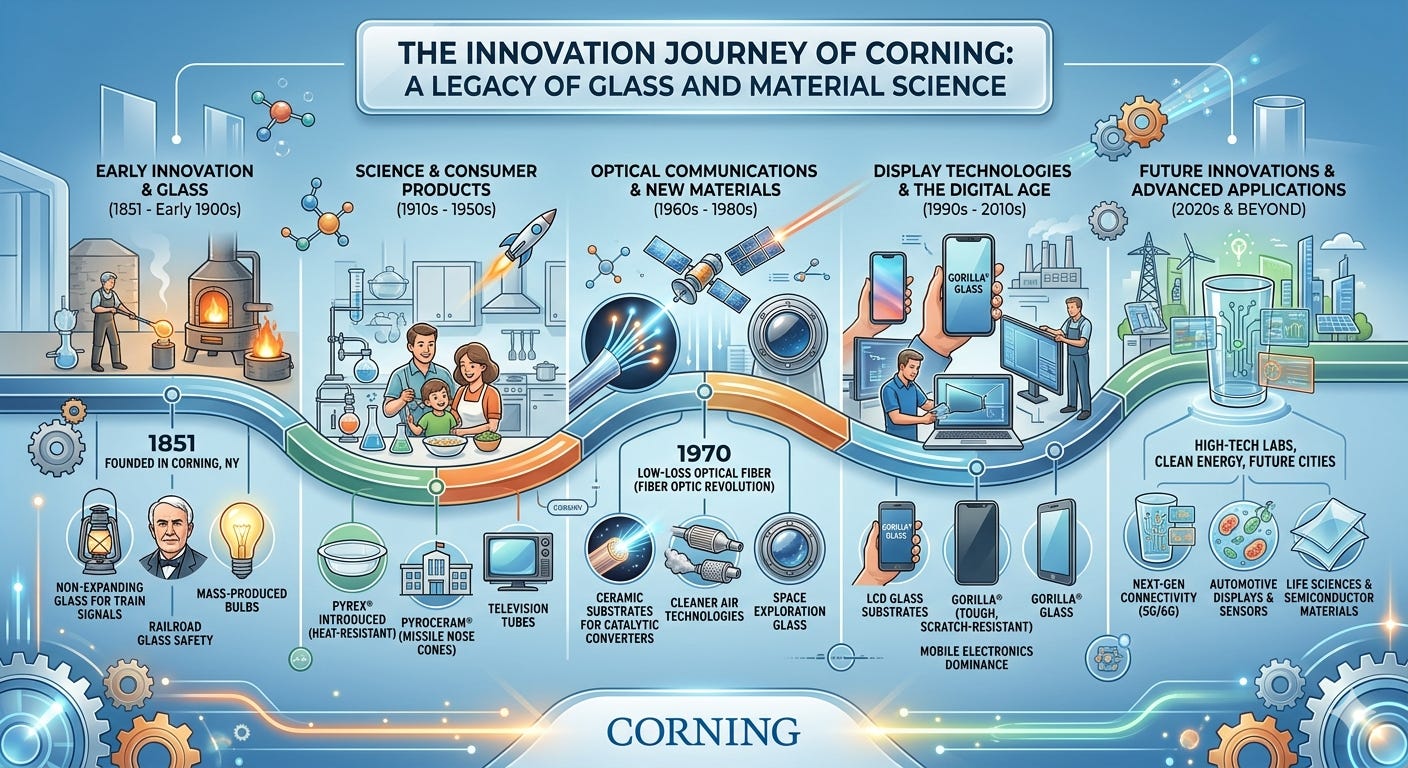
Transformation can be a misleading word. Most successful transformations involve holding on to some core capabilities. In fact, recognising what needs to stay is one of the most critical aspects of transformation. One of my favourite examples of this is Corning, which is a 170-year-old company that continues to be successful today. What hasn’t changed for corning is that at it’s core it’s a glass products manufacturer. Everything else about it has changed. From light bulbs to telecommunications and optical fibre to LCDs, to Gorilla Glass displays for smart phones - Corning has changed it’s technology, product mix, customer segments, and almost every part of it’s business.
Given that AI is actually a suite of technologies. And within that, you might find that reasoning technologies actually sustain some part of your business whilst generative AI or image recognition disrupts other bits. Weaving this understanding of AI capabilities across your map of competence areas may give you the best options for where you need to double down, and where you need disruption in your business.