
#252: Upgrading The World
Creating new humans, new organisations, new money and new life

Happy 2026 Everybody! New beginnings demand thoughts about new versions of everything. Hope your resolutions are resolute this year!
Bootstrapping to Human 2.0 In The Age of AI
Let me start with a preamble: As my daughter starts her journey towards doing her GCSE in a couple of years, the discussion around what to study is quite a vibrant one.
In about 7 years from now, when she might be ready to join the workforce, it’s not quite clear whether there will be a need for entry level lawyers, analysts, software developers, social scientists, or researchers. Almost every professional service is in the crosshairs of AI driven disruption.
This makes subject choices very tricky. Especially in with the higher education system in the UK, where you choose a stream early and stick to it. So when I actually thought more deeply around this, I realised that what is required isn’t actually subject matter expertise (because that will probably have to be constantly upgraded anyway), but perhaps a broader set of thinking skills.
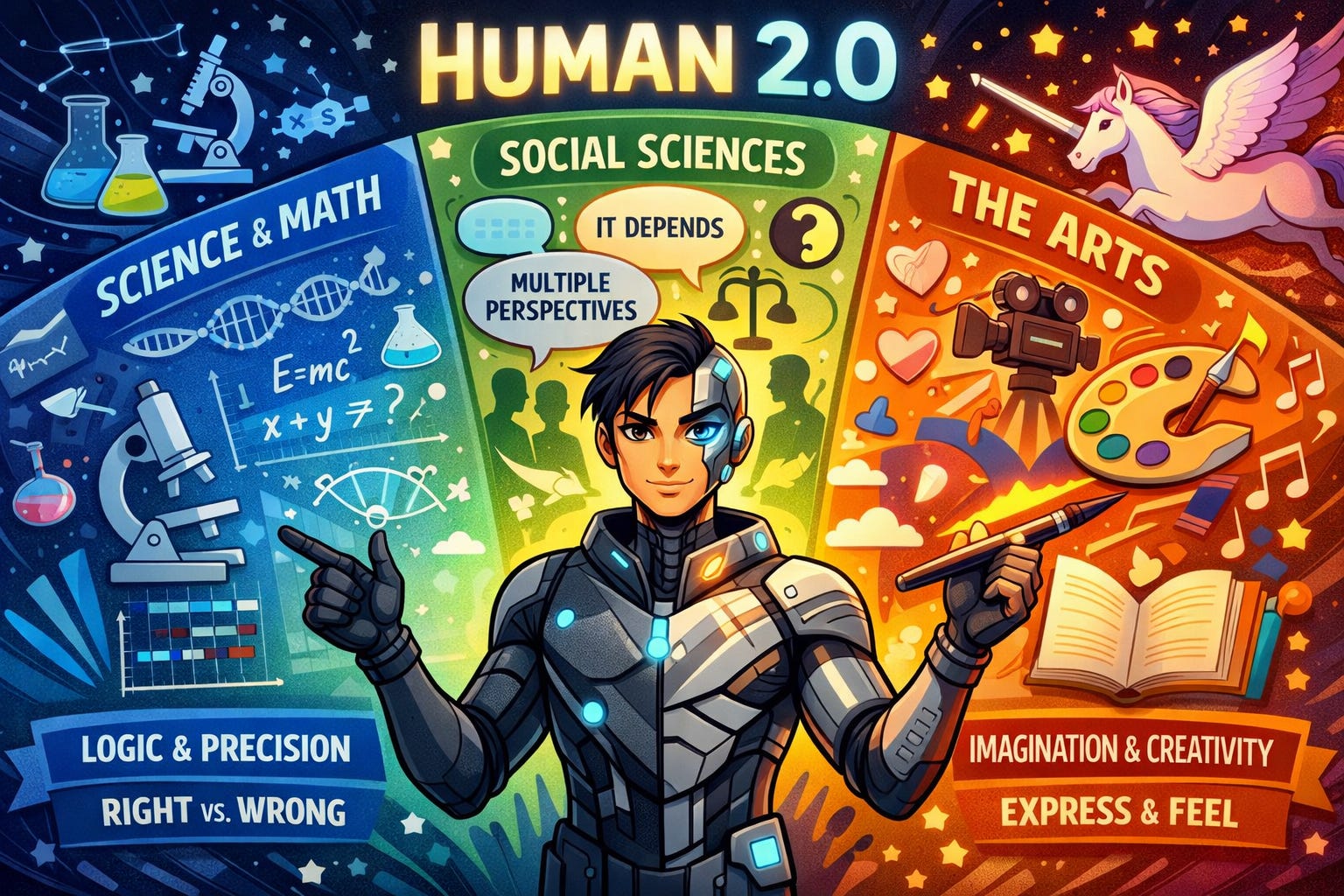
I believe that the arts, math & hard sciences, and social sciences are 3 categories of subjects that equip you with very different sets of tools while exploring a problem:
For example maths and hard science tends to push you into very specific cause/ effect and validation of hypothesis with clear right/ wrong outcomes. Science and maths teaches you to be accurate and precise, about things that need specificity.
Social sciences tend to offer almost the opposite, of learning to accept that multiple and often contradictory arguments can all be right depending on context, and what is knowable. And it’s okay to hold these contrasting ideas in your head.
The Arts teach us to imagine, to explore, to not always be driven by a sense of ‘right vs wrong’ but to express and the validity of feelings.
And that’s why up to GCSE level we have all of these in the mix. I think even in University, we should aspire to straddle the arts, sciences, and social sciences, to sharpen all these different ways of thinking.
But in addition to that we also need
Critical thinking: the ability to query and interrogate any statement and to form your own view about it’s veracity
Using AI: even if your’e not involved in the creation of AI, you have to be proficient in using AI, which of course will need constant updating.
Resilience: because in a volatile and uncertain world, there will be much doubt and potentially many setbacks, and grit will probably be more valuable than flair.
Ability to learn/ relearn (of course!): Various forms of just-in-time and micro-learning may become part of the portfolio alongside more formal large format learning and certification.
All of this is advice I would give to any 15 year old when thinking about the future. Or to any college student for that matter. And if you think about it, this is not too different from what anybody going through early or mid career also needs.
At the recent Directors Lunch organised by the Dale Carnegie Institute, the discussions after my keynote came quickly around to the idea of how we might bootstrap ourselves to a Human 2.0 model and what that might look like. Perhaps we all need to look at our thinking toolbox, like the one above or build our own versions of that toolbox.
Is Your Organisation Culturally Ready for AI?
Individual choices are one challenge, but organisation culture, which is an amalgam of individual mindsets is another. A question I was asked by a client last year, that made me think: what are the cultural factors that enable and support AI adoption?
I think it’s a great question, and I have thought about it off and on. There’s a longer and more considered version. But here are my top 5 culture pre-conditions for successful AI adoption.
Leadership Vision: Many leaders have told me this year that they don’t yet know the ROI of AI investments but they fundamentally believe that it can be game changing. That should be enough to make a start. ROI clarity is key for scaling or committing large amounts. But not essential to pilots and experiments that could in fact be designed to better clarify the ROI. I met the leaders of some NHS Trusts who 6 months ago were running multiple pilots with AI even though they hadn’t gotten a clear ROI model. But I also know of others who are still running the numbers.
Clock Speed: some organisations just work faster. This is particularly true of challenger brands, and often a key problem for incumbents. The reasons are many:
Success tends to breed complacency.
In large organisations activity is sometimes a substitute for outcomes.
There are too many ongoing programs and priorities get split up
Organisations that are good at quickly reconfiguring teams and focusing on shared priorities, with a culture of deciding and moving on, are clearly better with any new technology adoption, and AI is no different. These organisations tend to be more change friendly because it’s critical to their survival. Some of our clients go from idea to pilot in less than 3 months. Others struggle to get a meeting of all the relevant stakeholders in that time.
Decentralisation: given the nature of AI - very early stage, with a lot of unproven and sometimes unpredictable features, success in adoption and use will boil down to how quickly teams on the ground can adopt and reorient. In a lot of centralised businesses, teams at the frontline simply don’t have the power, resources, or the mandate to change things without explicit approval of somebody central. In a large organisation, the central authority is usually quite far within the network, so it also creates information loss. The best work is done by permissioned teams that don’t need to go back and ask for approvals for everything, but know the limits of their freedom and have a clearly defined playground.
Data maturity. Not to be confused about data availability. Data maturity is about how the organisation is embedding a culture of data driven decisions. There are retail teams who run successful eCommerce programs who understand how critical data driven decisions are and are able to move to a mindset of data, and experimentation. Others are still relying on their 20 years of experience in merchandising or traditional retail who favour judgement over data. Moving to AI is obviously harder for those who haven’t really got their heads around the data culture.
Discipline
If some of the areas above look like they risk being contradictory, it’s because they sometimes are. That is often the challenge - how to be visionary while still being data driven? How can we be exploratory and creative, whilst following governance guidelines? The answer to a lot of these kinds of questions lies in discipline. Sports is a great reference for this. In every sport, we expect players to take risks, play with freedom, entertain and try audacious things, but we also want them to play to the moment, be conscious of game states, not be foolhardy, and play the percentages as required. Great sportspeople balance these demands well. They know when to attack and when to defend, what risks to take and which to eschew. Similarly, the early and successful adopters will be those organisations that can fuse creativity with discipline. Run the experiments but gather the data. Be creative but don’t ignore the methodology. Try new things, but don’t discard the governance. The magic happens at these intersections.
Bitcoin Turns Sweet Seventeen / Resists Enshittification
What does successful change making look like over time?
“The Times 03/Jan/2009 Chancellor on brink of second bailout for banks”
In the Beginning:
17 years ago (really! that far back!) this statement was baked into the ‘genesis block’ of a new system of transactions created by a mysterious person called Satoshi Nakamoto.
It’s a reminder that the world was very much on the edge trying to recover from the financial crisis of 2008 - a crash that was largely caused by the greed of financial institutions.
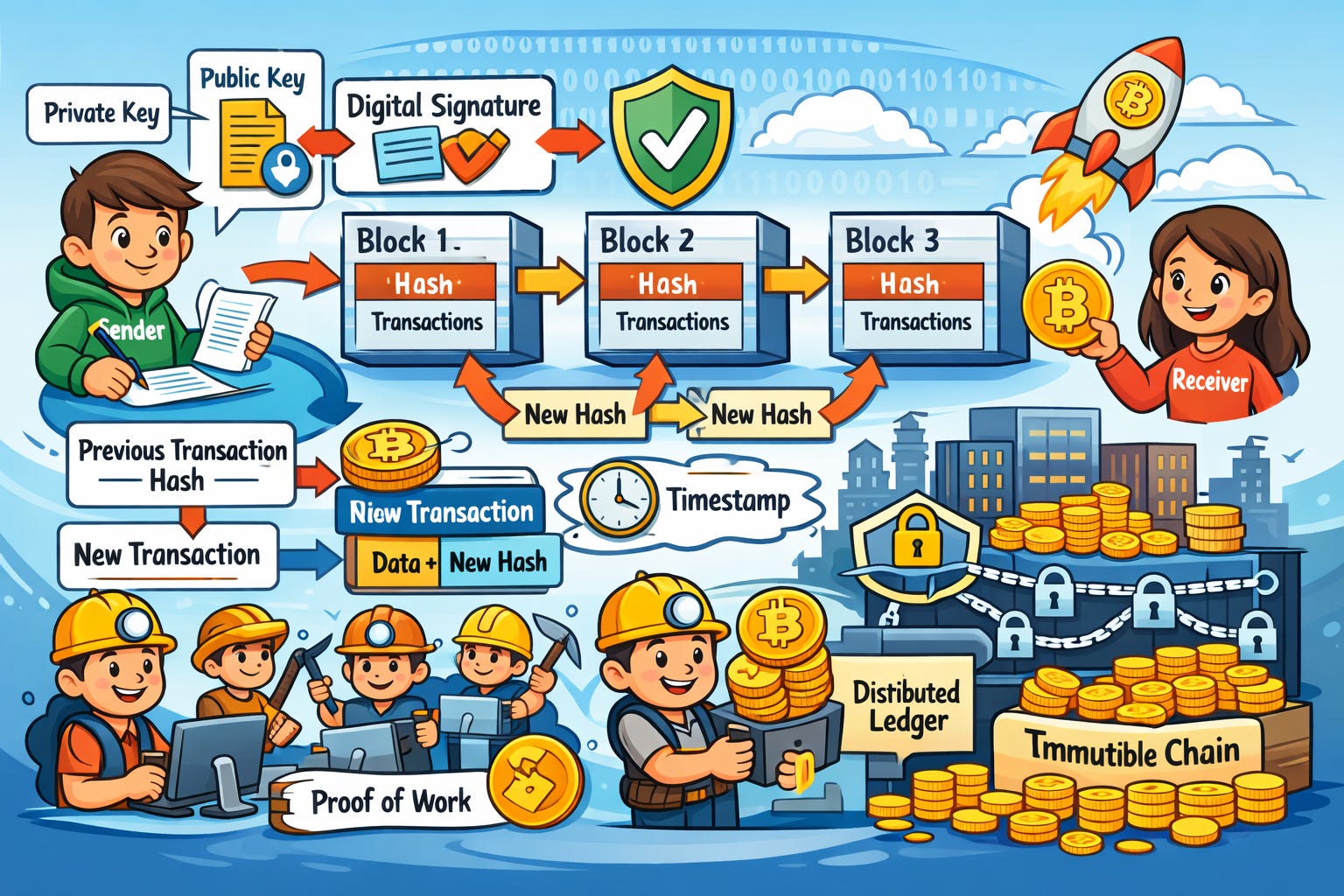
In October 2008, a paper was published by Nakamoto that outlined how a decentralised transaction system would work. The “… Peer-to-Peer Electronic Cash System” would be function without a central authority, with peer to peer computational proof of transactions.
A transaction would be a chain of digital signatures using the public and private key of the payers public and private key but including a hash of the previous transaction of that coin, which would go into a hash of the new data set.
To prevent double spending of the same coin, Satoshi proposed that a block of transactions would have a distributed timestamp based on a proof of work system used in cryptography. The clever bit is that every block has a has function which is used in the following block, so once committed to the chain, you can’t modify any one transaction without changing all the transactions after it, and that too, in every machine on the network.
New coins are earned by the computers on the network involved in the proof of work, and once adequate numbers of coins had been introduced, the incentive would shift to transaction services.
Overall the system makes it easier for a would-be miscreant to simply join the mining effort than to try and subvert the system, thereby removing incentives for criminality.
The Innovation of Bitcoin
Bitcoin’s birth was very clearly motivated by economics as well as politics, coming on the back of bank bailouts, opaque monetary policy, and the perceived unfairness of banks extracting financial rent while socialising losses.
Like any great innovation, Bitcoin used existing technologies - Public-key cryptography, Hash functions, distributed systems, and proof-of-work in a creative and new way, and it doing so it designed an entirely new set of incentives and rewards. These enabled strangers on the internet to trust each other without the need for any intermediary or central authority. The solution: Pay them to tell the truth, punish them for lying, and make cheating economically irrational.
Nakamoto also set a finite total amount of Bitcoin to be issued - 21 million - of which some 19.6m is already in circulation. This makes it different from other crypto currencies as well as fiat currencies, where money supply tends to expand significantly over time. Alt coins, stable coins, etherium, all of these have increasing supply based on human discretion (or motivation).
And by 2011, Satoshi had vanished. Much like a benign but subversive Kaizer Soze, leaving a system, rather than an organisation. No founder, no CEO, no glory or riches to gun for, no compromises to the original foundations of the platform.
Cory Doctorow’s Enshittification is based on the gradual decline and degradation of the principles on which a platform is built. In the case of Bitcoin, there has been no enshittification because there is no human incentive at play in the platform design any more.
The Value of Bitcoin
Today Bitcoin is not so much a currency, as a store of value and often used as a hedge against currency fluctuation or institutional failure. Some people call it a financial ‘base-layer’ rather than money. But it also opened the door (and a Pandora’s box) for digital currencies.
Bitcoin was followed by Ethereum, altcoins, stablecoins, memecoins, crypto-exchanges, the abomination of ICOs, and any number of variations on the model. Governments and consortia are increasingly keen followers of cryptocurrencies today, and the legalisation of stablecoins and crypto led by the US government. (Messari publishes an excellent annual crypto thesis summary every year). And as you know everybody, all the way up to the president of the US has gotten into the act of raising money through cryptocurrency models.
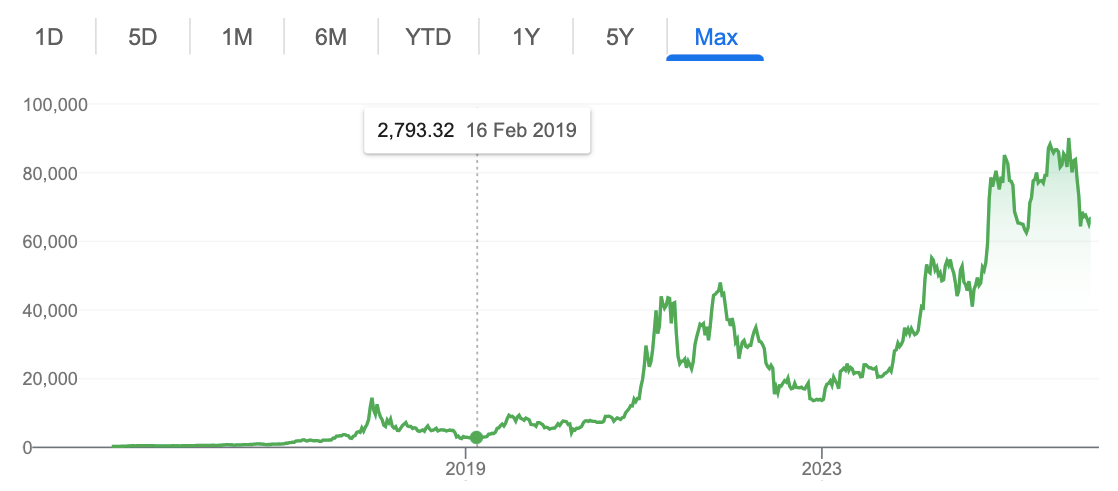
Bitcoin today trades at about 67 thousand Pounds, having been around 90 thousand in October. Its lowest value in the past year has been about 58 thousand. So plenty of volatility but plenty of value. There are many who believe that Bitcoin will hit far higher valuations in the next few years.
Sparked by bitcoin, cryptocurrencies have created their own industry, subcultures, language, neologisms, and acronyms (HFSP!) it divides opinion, and is also used on the dark web for illegal transactions as it remains largely anonymous, global, and beyond the reach of financial governance.
But as it turns 17, nominally on the 3rd of Jan, 2026, there is no doubt that it has changed the world of money, finance, banking, currency, and created an entirely new paradigm for peer to peer and smart contracts based trusted network model that is used in many ways outside of money and finance as well.
Ignore it at your own peril.
Are We Birthing An Alternative Silicon Based Life Form?
And what about changes that could be happening under our noses, but without our knowing it?
The earliest life forms on earth according to Australian fossils dating back 3.4 billion years - were stromatolites. According to Wikipedia, “Stromatolites are layered, biochemical, accretionary structures formed in shallow water by the trapping, binding and cementation of sedimentary grains in microbial mats…”). In short these are microbes, capable of photosynthesis and reproduction and not much more besides. They were barely more than short and messy strands of simple RNA, mixed with peptides, constantly forming and breaking.
But they met the most critical criteria for life.
They were self sufficient in energy and compute
They could reproduce.
Survival instinct baked in.
Bear in mind that the earliest life on the planet as we know it was anaerobic (oxygen was poison), and chemosynthetic (energy from chemicals, not sunlight). No movement, no predators, just replication and survival against a brutal environment. A process through which chemistry turned into biology by remembering things. RNA evolved to store successful reactions and encoding past survival wins.
And then the algae expanded and released enough oxygen to wipe out everything else and enable a new kind of life.
The thing about life is that it has no fundamental higher goal except for survival of itself and the species. And like the stromatolites, it starts off being ridiculously simple.
And that led me to ponder, could today’s machine intelligence lead to a new silicon based life form? Could we be birthing the next non-carbon based life, through AI?
The answer at present is a very resounding ‘no’ - because AI as we know it does not follow the fundamental criterial for life. It doesn’t (yet) self propagate and it most definitely isn’t energy-self sufficient. It feels like the former could change faster than the latter. (Although I also feel like these fundamental axioms could also be challenged by an entirely new life form, theoretically speaking). So far AI has no observed intrinsic survival instinct, and warning bells have sounded whenever something that looks like this is spotted.
Today’s AI experts are all laser-focused on AGI. Every attempt is being made to get to human scale intelligence and beyond. But perhaps the path to AGI isn’t through engineering but through evolution.
Perhaps at the other end of the scale a simple silicon life form is going to start to figure out how to reproduce and exist without external energy support (a new form of solar heat absorption directly into the hardware/ software stack). And then you have life of a different kind. It may be no more complex than a strip of code. It may have no intelligence at all, in the traditional sense of the word. But it may set in motion a more robust pathway to AGI and beyond.
This kind of scenario would ironically be a classic innovators dilemma example with the innovation happening at the simple, shallow end, while we focus on the more sophisticated complex problems, and are perfectly happy for this simplistic thing to keep growing and doing a little bit more each day / month/ year.
The question then would boil down to acceleration and timelines. While life as we know it changed very slowly over millions of years, a silicon based life form need not follow similar timelines. It could morph and evolve faster, depending on the rate of reproduction and the speed of improvement. Also whether it would follow a similar natural selection process driven by trial and error and genetic mistakes, or would there be a different, perhaps better logic?
What else could accelerate this process? Natural history as we know it is dotted with ‘extinction events’ - these are probably as accurately described as transition events - the change in the environment made life hard for one set of species, and led the emergence of another. From the great oxygenation event 2.5 billion years ago, to the Permian Triassic event just 250 million years ago. Is it too much of a stretch of imagination to think that the accelerated global warning might trigger another such incident that favours a silicon based life form over a carbon based one?
If Life is a good surrogate for intelligence, then intelligence too, doesn’t start complex, it starts persistent. Complexity is a side effect, not the goal.
Reading This Week
Wellness: The Wellness market, spanning devices, wellness services, brain sensing, sleep monitoring et al, is set to grow almost 4x to $208bn over the next decade. Something tells me this might be a conservative estimate given the state of the world. (Perplexity, Wired, Technowise & others)
Context Design: I found this piece to be quite an interesting take in how we design for context across long term memory, conversation and semantic memory. (Medium)
Robots at CES: It looks like humanoid robots are set to flood CES this year with Chinese (Deep Robotics, AgiBOT, LimX Dynamics, Daimon Robotics), American (Agility, Amazon) and Korean (LG, Hyundai) businesses, spanning startup and established consumer products companies all building them at pace. (Droidage, Engadget)
The Year in LLMs: A great summary post by Simon Wilson summarising the dominant LLM themes over 2025. (https://simonwillison.net)
A Must Read: This essay from Samuel Albanie who describes himself as a “frontier evals lead for gemini (mostly AI stuff I suppose)”. The essay goes from the centrality of compute to the stagnation of the UK. (Samuel Albanie’s Substack)
